
REVIEW · WALKING TOURS
Christchurch Essentials Guided Walking Tour
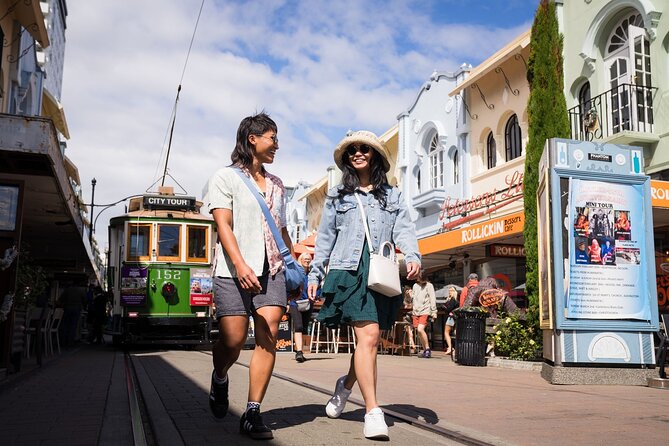
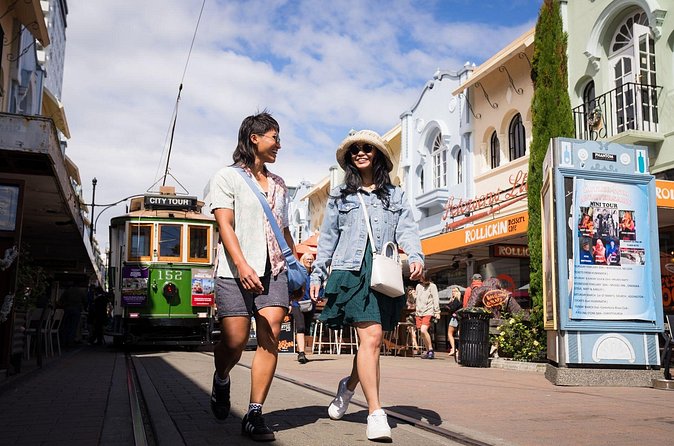
Christchurch tells its story on foot. This compact walking tour links Māori traditions, English settlement, earthquake recovery, public art, science, gardens, and riverside life in about 1 hour 40 minutes. I like the way it treats Christchurch as a living city rather than a museum, and I especially like the attention given to the 2010 and 2011 earthquakes and the city’s ongoing renewal. The main consideration is pace: with 15 stops, some places receive only a few minutes, so you may want to return later to explore favorites properly.
I also like the small-group limit of 12 people, which should make it easier to hear the guide and ask questions. A local guide can add the human detail that a map cannot, and one guide patiently waited while Linda took photographs, a useful sign for anyone who prefers not to rush. The tour requires good weather, and its long list of stops means it works best as an introduction rather than a full visit to every attraction.
In This Review
- Key points before you book
- Starting beside the Bridge of Remembrance
- The Terrace, Riverside, and City Mall
- Cathedral Square and Christchurch’s hardest chapter
- Tūranga and the Avon River Ōtākaro
- Victoria Square and the Scott statue
- Art, education, and the city’s intellectual side
- Christchurch Botanic Gardens and Hagley Park
- Antigua Boatsheds and the Avon River
- The Canterbury Earthquake National Memorial
- What the pace and group size mean
- Is $15.51 good value?
- Who should book this Christchurch walk?
- Final verdict: book it for context, then explore further
- FAQ
- Where does the Christchurch Essentials Guided Walking Tour start?
- Where does the walking tour finish?
- How long does the tour last?
- What time does the tour start?
- How much does the tour cost?
- How many people can join the tour?
- Is the tour suitable for most participants?
- What happens if bad weather cancels the tour?
Key points before you book
- Starts at the Bridge of Remembrance: Tours leave daily at 10 a.m. and 1 p.m. from Cashel Street.
- Covers 15 central-city stops: You see the river, main civic spaces, memorials, galleries, gardens, and heritage buildings.
- Earthquake stories are central: Cathedral Square and the Canterbury Earthquake National Memorial help explain Christchurch’s modern identity.
- Small group, short duration: The maximum group size is 12, and the walk lasts about 1.5 to 1.75 hours.
- Good value at $15.51: The price is modest for a guided introduction to so many central landmarks.
- Ends where it begins: You return to the Bridge of Remembrance, making it easy to continue exploring on your own.
Starting beside the Bridge of Remembrance
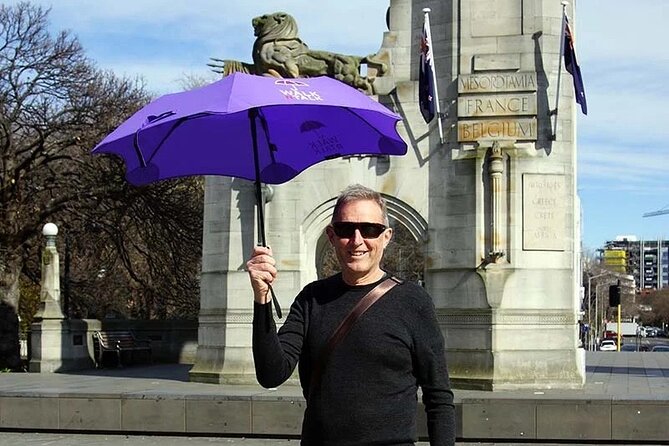
The tour begins at the Bridge of Remembrance on Cashel Street, a fitting place to set the tone. This landmark connects the city’s older civic story with its modern recovery, and the short opening stop gives your guide a chance to explain where you are before the walk moves into the center.
The first few stops are brief, only a few minutes each. That is useful if you want a broad orientation without giving up half a day, but you should not expect a long formal talk at every location. The guide’s role is to connect the places, explain their meaning, and point out where you may want to return.
This opening part should also help you get your bearings. The tour remains within Christchurch’s central area, and the route is designed around places that work well together on foot. You will be walking and stopping often, so comfortable shoes are sensible even though the overall duration is manageable.
More Walking Tours in Christchurch
- Full Day Guided Walking Tour and Picnic around Godley Head
★ 5.0 · 147 reviews - Ōtautahi: Christchurch Small-Group Inner City Food Walking Tour
★ 5.0 · 85 reviews - Christchurch: Guided Crater Rim Walk with Coastal Scenery
★ 5.0 · 56 reviews
The Terrace, Riverside, and City Mall
From the Bridge of Remembrance, the walk heads toward The Terrace and the Riverside 3D mural. These early stops show the city’s newer public face, where commercial areas, riverfront spaces, and creative design have helped change how the center feels after the earthquakes.
The Riverside 3D mural gets only a short stop, but it offers a quick example of Christchurch’s use of public art. You may want a photograph here, so keep your camera ready. The guide can give the mural context, while you get a visual break from the historical sites.
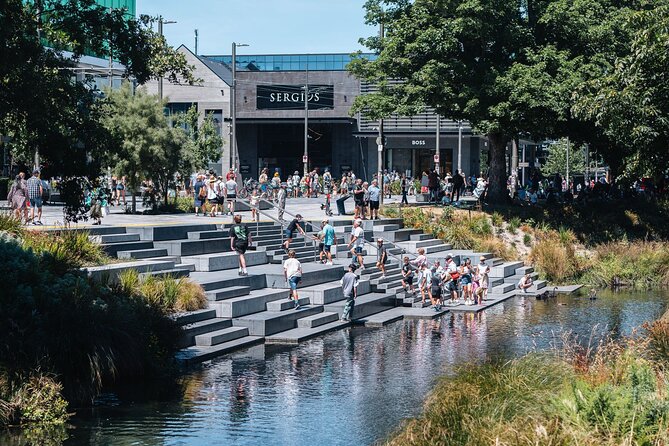
City Mall follows, with another short pause. This is a practical place to see how the center has been rebuilt and refreshed for everyday use. I like this part because it keeps the tour from becoming a string of statues and old buildings. Christchurch’s recovery is not only about memorials. It is also about shops, gathering spaces, design, and getting people back into the heart of the city.
The drawback is that the short timing leaves little room for browsing. If you want to shop, eat, or study the public art, save that for after the walk.
Cathedral Square and Christchurch’s hardest chapter
Cathedral Square receives one of the longer stops, about seven minutes. It is one of the most important places on the route, and it gives the guide a natural setting for explaining Christchurch before and after the earthquakes.
The 2010 and 2011 earthquakes changed the city in ways that are still visible. Cathedral Square helps you understand why recovery has taken time and why Christchurch has adopted so many new approaches to public space, building, and city life. The guide also connects the earthquake story with the wider account of Māori heritage and English settlement, giving you a fuller sense of the city’s past.
You should expect this section to be thoughtful rather than light entertainment. It is not just a stop for photographs. The history here includes loss, disruption, and rebuilding, so the guide’s explanation matters. The tour later visits the Canterbury Earthquake National Memorial, giving you another, more direct place to reflect.
Because the itinerary is compact, the guide cannot explain every building or every stage of the recovery. Still, this is one of the places where a local perspective adds real value.
Tūranga and the Avon River Ōtākaro
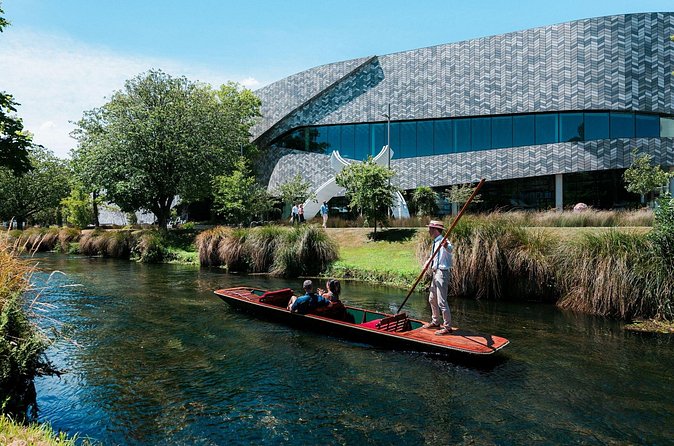
Tūranga, Christchurch’s central library, is the next major stop. The tour allows about five minutes here, enough to introduce the building and its place in the renewed city center.
Tūranga represents the idea that a rebuilt Christchurch should serve daily life, not simply replace what was lost. A library is a useful symbol for that change: public, practical, and open to the community. Your guide can help place it within the city’s wider plans for renewal.
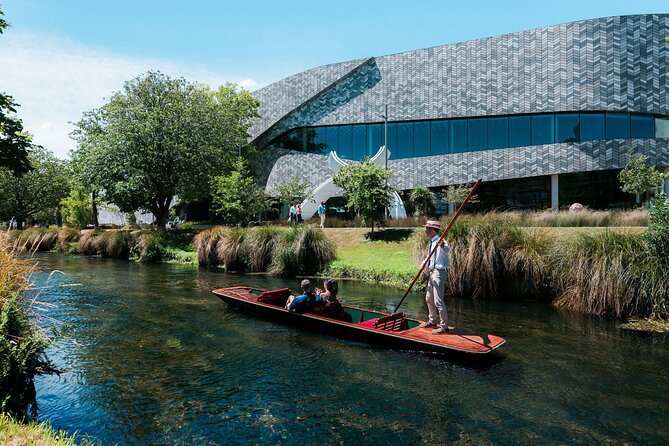
The route then reaches the Avon River, known as Ōtākaro. The river gives the walk a slower moment. After the hard facts of earthquakes and redevelopment, water and open space help you see another side of the city. The stop lasts about four minutes, so expect an introduction rather than a long riverside stroll.
I like this contrast. The tour moves between buildings, public art, memorials, and the river, which gives you a more rounded picture of Christchurch. If you enjoy the river setting, note the location for a later return, since the guided stop is brief.
A completely different sort of day out:
- Christchurch Hop-On Hop-Off Tram
★ 4.5 · 841 reviews - Christchurch Gondola and Tram City Tour Combo
★ 4.5 · 725 reviews - Christchurch: Hop-On Hop-Off Tour by Vintage Tram
★ 4.6 · 717 reviews - Christchurch: Tram, Punt and Gondola Ride Combo Ticket
★ 4.7 · 608 reviews
Victoria Square and the Scott statue
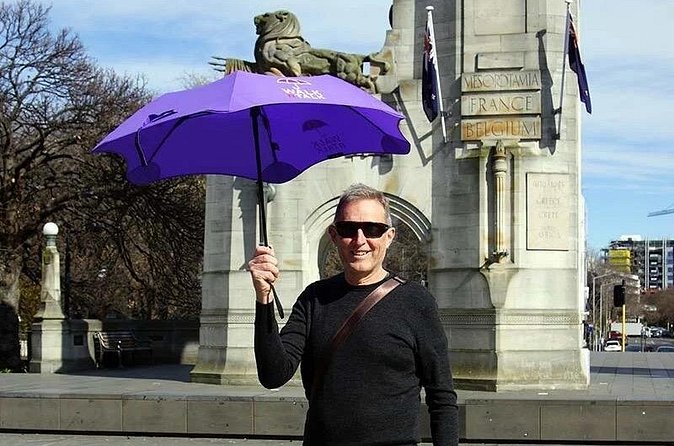
Victoria Square receives about five minutes. This civic space adds another layer to the route, linking Christchurch’s public life with its older monuments and landscaped areas.
The nearby statue of Robert Falcon Scott also receives about five minutes. Scott is associated with Antarctic exploration, and the statue gives the guide a chance to connect Christchurch with that wider part of New Zealand’s story. The stop is a reminder that the city’s identity is not limited to local events. Its public monuments also point toward science, exploration, and the country’s connections beyond the South Island.
These stops are best understood through explanation. A statue or square can be easy to pass without noticing, but a guide can tell you why it was placed there and what it says about the city. At the same time, the short stops mean you should not expect an extended discussion of Scott’s expeditions.
Art, education, and the city’s intellectual side
Christchurch Art Gallery, Te Puna o Waiwhetū, follows. The tour allows around five minutes, which is enough to identify the gallery and explain its role, but not enough for a proper gallery visit. If art matters to you, plan to return separately.
The Arts Centre Te Matatiki Toi Ora receives around seven minutes and is one of the more substantial stops. It contains New Zealand’s largest concentration of Grade 1 heritage buildings. The complex was once home to Canterbury College, along with the city’s boys’ and girls’ high schools, and it has since been repurposed as an arts center.
That change in use is exactly the sort of detail that makes the walking tour worthwhile. You are not simply looking at handsome old buildings. You are seeing how Christchurch has respected its past while giving those buildings a new public purpose.
Rutherford’s Den adds a science story. Ernest Rutherford studied here, and Albert Einstein described him as a second Newton who had tunneled into the very material of God. The stop focuses on Rutherford’s foundational work concerning the structure of the atom.
For me, this is one of the route’s more unusual inclusions. Many city walks stick to churches, monuments, and government buildings. Rutherford’s Den shows that Christchurch also has an important academic and scientific history. The five-minute stop will not turn you into a physicist, but it gives you a memorable reason to return.
Christchurch Botanic Gardens and Hagley Park
The tour then reaches the Christchurch Botanic Gardens, described as one of New Zealand’s best gardens. The stop lasts about five minutes, which is enough to point out the setting and suggest what lies beyond the route.
This is an important practical detail: the Botanic Gardens and Hagley Park are much larger than a short guided stop can show. Hagley Park covers 407 acres, so if you enjoy gardens, open space, or quiet walks, plan extra time here after the tour. The option to hire an electric scooter later is also noted, which may appeal if you want to cover more ground without committing to a long walk.
The brief visit is both a strength and a limitation. You get a useful introduction without spending too much time away from the central city, but garden lovers may feel that five minutes is only a preview. I would treat this stop as a recommendation for further exploring, not as a full garden visit.
Antigua Boatsheds and the Avon River
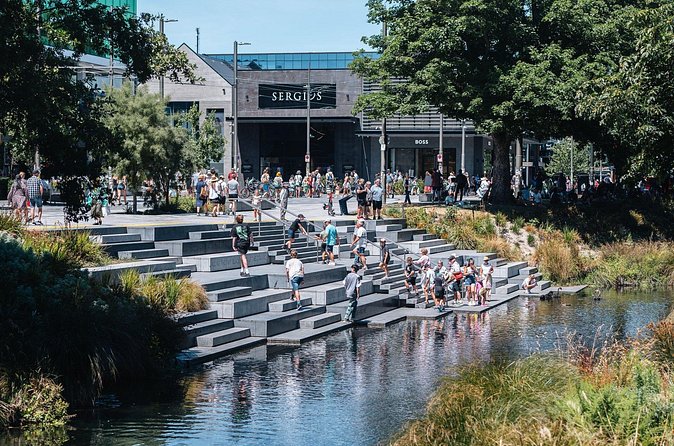
At the Antigua Boatsheds Canoe Hire, the guide points out the river’s long boating tradition. People have canoed up and down the Avon since the 1880s, giving this stop a pleasant link between history and present-day recreation.
The stop lasts about three minutes. That is enough to show you where to continue your own river experience, but not enough for canoe hire itself to form part of the walking tour. If paddling appeals to you, this is a useful place to note for later.
I appreciate the way this stop keeps the tour connected to ordinary leisure. Christchurch is not presented only through disaster, heritage, or civic rebuilding. The river is also a place where people have spent time outdoors for generations.
The Canterbury Earthquake National Memorial
The final listed stop is the Canterbury Earthquake National Memorial. The memorial honors the 185 people who lost their lives in the February 2011 earthquakes, and the tour allows about three minutes here.
That may sound short for such a serious site, but the memorial is a place where a quiet pause can matter more than a long speech. The earlier visit to Cathedral Square gives you the citywide context. Here, the focus becomes personal and human.
This is likely to be one of the most affecting parts of the walk. You should not expect the guide to turn it into a dramatic performance. The value comes from understanding what the memorial represents and allowing yourself a moment to reflect.
Since the tour returns to the Bridge of Remembrance, you finish close to where you began. That makes it easy to continue to the Botanic Gardens, spend more time at the Arts Centre, visit the art gallery, or find food around the central city.
What the pace and group size mean
The tour lasts approximately 1 hour 40 minutes, with the stated walking time ranging from 1.5 to 1.75 hours. The difference likely reflects the number of questions, photo pauses, and discussion at each stop. It is not a rushed sprint, but it is also not a leisurely half-day walk.
The maximum group size is 12. That is a useful limit for a city tour because it should allow you to hear the guide and ask questions without standing in a large crowd. One direct account praised a local guide for being well-informed and for patiently waiting while photographs were taken. That detail matters more than polished marketing language. A guide who gives you time to look is a better fit than one who marches everyone from point to point.
Tours start daily at 10 a.m. and 1 p.m. The morning departure may work well if you want the rest of the day for museums, gardens, or river activities. The afternoon option suits a later start, though you should check your own plans around the tour’s approximately 100-minute duration.
The experience requires good weather. Christchurch’s weather can affect the comfort of an outdoor walk, and poor conditions may lead to a different date or a full refund. Free cancellation is available if you cancel at least 24 hours before the start time. Changes or cancellations inside that window are not accepted for a refund.
Is $15.51 good value?
At $15.51 per person, this is priced as an inexpensive orientation rather than a premium guided experience. I think the value is strong if you want local context quickly and plan to explore some places on your own afterward.
You are not paying for admission to a major attraction or a long specialist lecture. You are paying for the route, the guide’s interpretation, and the links between places that can otherwise seem unrelated. In less than two hours, you reach the Bridge of Remembrance, Cathedral Square, Tūranga, the Avon River, Victoria Square, the art gallery, the Arts Centre, Rutherford’s Den, the Botanic Gardens, the Antigua Boatsheds, and the earthquake memorial.
The price is less compelling if you want extended time inside buildings or gardens. Several stops last only three to five minutes, and the tour does not provide a full visit to the art gallery, Arts Centre, or Botanic Gardens. But for first-time orientation, the low cost makes it easy to justify.
Who should book this Christchurch walk?
I would recommend it to first-time visitors who want to understand the central city before choosing where to spend more time. It also suits people interested in earthquake recovery, public art, local history, architecture, science, and urban renewal.
The walk may work well for solo visitors because a small group and a local guide can make the city easier to read. It also suits most people who can participate in a normal city walking tour. Service animals are allowed, and the meeting point is near public transportation.
You may want another option if you dislike outdoor walks, need long visits at each attraction, or prefer a single subject such as gardens, architecture, or earthquake history. This tour covers many subjects, which is its strength, but it also means none receives a full treatment.
Final verdict: book it for context, then explore further
Book the Christchurch Essentials Guided Walking Tour if you want a low-cost, small-group introduction to the city’s past and next chapter. Its best features are the local guide, the patient approach to photographs, the strong earthquake context, and the mix of civic, cultural, scientific, and natural sites.
Go in expecting a guided overview, not fifteen complete attraction visits. Keep the Botanic Gardens, Arts Centre, art gallery, or river boating in your plans for later. With that expectation, the tour gives you a useful map of Christchurch and a better sense of why the city continues to draw people from overseas and from across New Zealand.
FAQ
Where does the Christchurch Essentials Guided Walking Tour start?
The tour starts at the Bridge of Remembrance on Cashel Street in Christchurch Central City.
Where does the walking tour finish?
The activity finishes back at the Bridge of Remembrance, its starting point.
How long does the tour last?
The tour lasts approximately 1 hour 40 minutes. The stated walking and exploration time is about 1.5 to 1.75 hours.
What time does the tour start?
Tours start daily at 10 a.m. and 1 p.m.
How much does the tour cost?
The listed price is $15.51 per person.
How many people can join the tour?
The maximum group size is 12 people.
Is the tour suitable for most participants?
Most people can participate, and service animals are allowed. The activity is a walking tour and requires good weather.
What happens if bad weather cancels the tour?
If poor weather causes cancellation, you will be offered a different date or a full refund. You can also cancel at least 24 hours before the start time for a full refund.
Just added in Christchurch
- Wine trail and Christchurch City – Luxury, Small Group Tour★ 5.0 · 15 reviews
- Waipara Wine Trail Tour From Christchurch★ 5.0 · 1 review
- Willowbank Wildlife Reserve Day Entry★ 4.5 · 94 reviews
- Waipara Wine Trail Private Group Tour From Christchurch★ 5.0 · 1 review
- Waimakariri River Jet Boating from Christchurch★ 4.0 · 9 reviews
- Waipara Valley Winery Tour Wine Tastings and Scenic Views★ 5.0 · 5 reviews
- Trial Flight★ 5.0 · 1 review
- Uniquely Kiwi Landsailing Adventure★ 5.0 · 66 reviews
Walking Tours, compared.
Hobbiton™ Movie Set Walking Tour from Shires Rest
Read our review →
Rotorua’s Ultimate Zipline: 6 ziplines, 400 m Tandem, Cliff Walk
Read our review →
Waitomo Caves: Ruakuri Glowworm Cave Guided Walking Tour
Read our review →
Abel Tasman: Sea Shuttle Cruise and Walking Tour Combo
Read our review →

Browse the lists this tour appears in