
REVIEW · TRAIN EXPERIENCES
Dunedin to Queenstown One Way Tour Including Taieri Gorge Train
A train ride turns the transfer into an adventure. This nine-hour trip links Dunedin and Queenstown by combining the historic Taieri Gorge Railway with a small-group drive through Central Otago. I like the unusual route, especially the chance to see St. Bathans and Ophir rather than simply taking the fastest road. I also like the practical finish: your guide drops you at centrally located Queenstown accommodation.
The main drawback is the early, fixed schedule. You must reach Dunedin Railway Station on your own by 9:00 am, and the day includes a long train ride followed by several hours in a vehicle. For anyone wanting a leisurely day with long walks, meals, or many stops, this trip may feel tightly packed.
In This Review
- Key Things to Know Before You Book
- Why This Is More Than a Simple Transfer
- Starting at Dunedin Railway Station
- Two Hours Through the Taieri Gorge
- Meeting Jonathan at Pukerangi
- St. Bathans and the Blue Lake
- A Five-Minute Stop at Ophir Historic Bridge
- Cromwell and the Central Otago Interior
- Kawarau Gorge on the Way to Queenstown
- Arriving in Queenstown With Hotel Drop-Off
- Is $179.97 Good Value?
- Who Should Choose This Day Trip?
- Practical Details That Matter
- Should You Book the Dunedin to Queenstown Tour?
- FAQ
- Where does the tour begin?
- What time does the tour start?
- Is Dunedin hotel pickup included?
- How long does the experience take?
- Is the Taieri Gorge Train ticket included?
- Where do I leave the train?
- How many people can join the tour?
- Is Queenstown hotel drop-off included?
- How much luggage can I bring?
- Are child safety seats provided?
Key Things to Know Before You Book
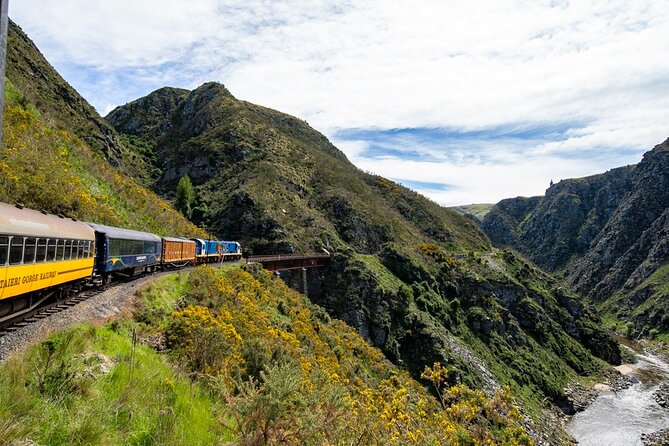
- The Taieri Gorge Train is the star opening act: You spend about two hours crossing gorges, canyons, and old viaducts between Dunedin and Pukerangi.
- The journey changes transport at Pukerangi: You leave the train at this remote high-country outpost and meet guide Jonathan for the road portion.
- St. Bathans gives the trip its character: The former gold-mining settlement and man-made Blue Lake offer an unusual stop far removed from standard coach routes.
- The group is limited to 15 people: That is a useful middle ground between a private tour and a large bus excursion.
- Luggage is built into the plan: You can bring one large bag and one small bag per person, which makes this a sensible option when changing bases.
- The price is $179.97 per person: Since the train ticket and Queenstown hotel drop-off are included, the cost can be fair for a full-day transfer with sightseeing.
Why This Is More Than a Simple Transfer
Dunedin and Queenstown are both popular South Island bases, but the usual transfer between them can become a long stretch of road. This experience gives you a reason to make the move during the day instead of losing the time to a standard bus or car ride.
The route also has a strong sense of place. You begin with Dunedin’s grand railway architecture, cross the Otago interior by train, then continue through small settlements shaped by gold mining, farming, rivers, and old engineering projects. By the time you reach Queenstown, you have seen a much broader slice of the region.
I especially like the change in pace. The railway section lets you watch the scenery unfold from a carriage, while the road section gives you short stops and closer views. You are not simply sitting in one type of transport for nine hours.
That said, this is still a full day. The listed duration is about nine hours, and some stops are very brief. You should book it for the route and the stories along the way, not because you expect extended free time in every town.
More Train Trips in Dunedin:
- Dunedin: Scenic Railway Tour Through the Taieri Gorge
★ 4.7 · 73 reviews - Queenstown to Dunedin Incl Taieri Gorge Train (One-Way)
★ 4.3 · 3 reviews - Dunedin: Scenic Railway Tour of Otago’s Coastline
★ 3.7 · 3 reviews
Starting at Dunedin Railway Station
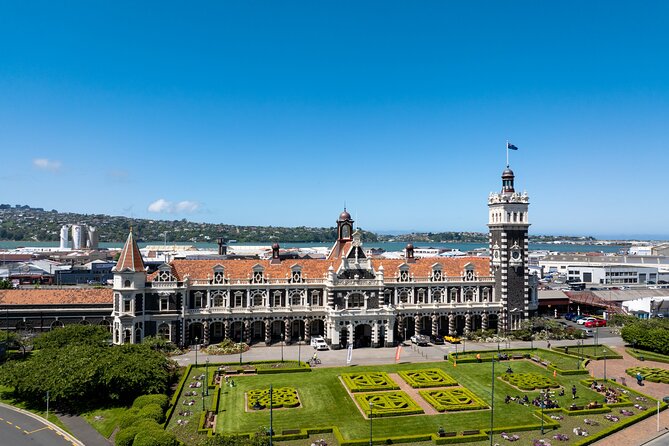
The day begins at Dunedin Scenic Train Tours, home of the Taieri Gorge Railway, at 22 Anzac Avenue. The meeting point is Dunedin Railway Station, one of the city’s best-known buildings and a fine place to begin the trip.
The station is famous for its elaborate design, so arrive with enough time to find the departure point and settle yourself before 9:00 am. Hotel pickup in Dunedin is not included. That detail matters if you are staying outside the central area or carrying several bags.
You should also think about breakfast before departure. No meal is listed as included, and the schedule is built around the train and road connections. The smart approach is to arrive ready for the day, with water and anything you need close at hand.
Two Hours Through the Taieri Gorge
The first section runs on the Taieri Gorge Railway from Dunedin to Pukerangi. The train ticket is included, and the journey takes about two hours.
This is the most distinctive transport segment of the trip. The railway enters narrow gorges and cuts through deep canyons, crossing viaducts built during an earlier period of Otago engineering. The setting changes quickly from Dunedin’s urban edge to rough inland country.
A guide provides commentary during the train ride. That adds useful context to the views, since the railway is not just a scenic ride. You are also seeing how people once connected Dunedin with the interior, where difficult terrain made transport a serious engineering task.
The train is a good fit if you enjoy scenery without needing to hike for it. You can sit back and watch the route develop, then save your energy for the road stops later. If you prefer a very active day, the two-hour ride may feel passive, but it provides a welcome pause before the next part.
The train ends at Pukerangi. This is not a major town with a long list of services. It is a remote high-country outpost and a practical changeover point. The small scale is part of the appeal, but you should not expect a full town visit here.
Meeting Jonathan at Pukerangi
At Pukerangi, you leave the train and meet your road guide, Jonathan. The second part of the trip is by vehicle through Central Otago.
A previous passenger singled out Jonathan’s stories, humorous trivia, and easy manner. That is important on a route like this, because the road section depends heavily on the guide. The towns are small, and a brief explanation can make the difference between a quick photo stop and a place you understand.
The road portion also changes the feeling of the day. On the train, the railway controls the route. With Jonathan driving, you move through a series of historic settlements and viewpoints, with time to stop at selected locations.
The group limit of 15 people should help keep the vehicle experience more personal than a large coach. It does not make the tour private, but it gives you a better chance of hearing the guide and asking questions.
A few more to weigh up in Dunedin
- Clearwater Wildlife Tours (small group 10max) Otago Peninsula
★ 5.0 · 531 reviews - Speight’s Brewery Tour & Guided Tasting
★ 5.0 · 508 reviews - Guided Evening Penguin Viewing Otago Peninsula, Dunedin, New Zealand
★ 5.0 · 471 reviews - Larnach Castle and Gardens Admission Ticket
★ 4.5 · 279 reviews
St. Bathans and the Blue Lake
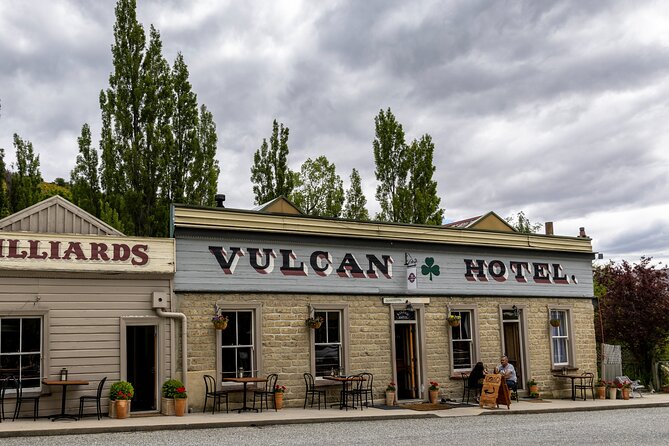
St. Bathans is the most unusual stop on the route. You have about 30 minutes to explore this former gold rush settlement, which has been preserved as a small ghost town.
The town’s appeal comes from its stillness. Old streets and buildings recall the period when gold drew people into the Otago interior. The setting is not polished or crowded, and that gives the stop a more distinctive feel than a standard photo break.
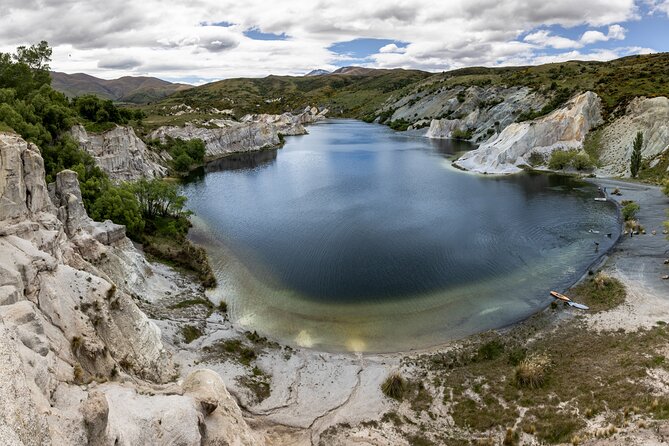
The Blue Lake is the visual highlight. It was formed by gold mining, so its color and shape are tied directly to the work that changed the area. The lake is not simply a pretty body of water. It is a visible reminder of the cost and scale of mining in this dry inland region.
Thirty minutes is enough for a look around and photographs, but not enough for a long walk or an unhurried visit. Keep your expectations in check. You will get an introduction to St. Bathans, not a full historical tour.
I would pay close attention to the guide here. The details about the settlement, mining, and Blue Lake are what give the stop meaning. Without that context, you could easily treat it as a quick scenic pause and miss why it is included.
A Five-Minute Stop at Ophir Historic Bridge
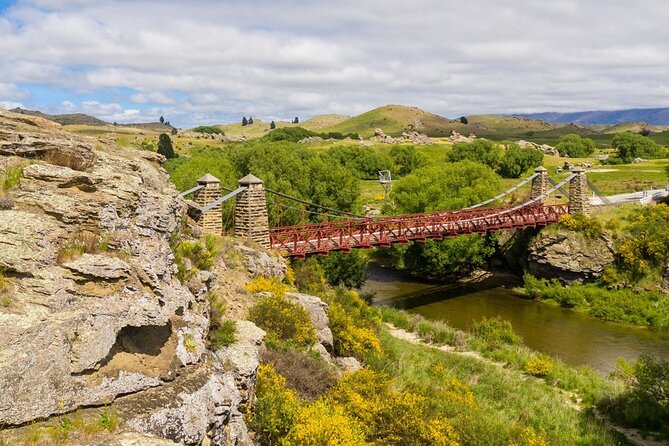
The next listed stop is the Ophir Historic Bridge, an 1880 suspension bridge over the Manuherikia River. The stop lasts about five minutes.
This is clearly a brief photography stop. You will have time to see the bridge, take pictures, and appreciate the old engineering, but not to explore Ophir in depth.
The bridge is a useful reminder that Central Otago’s story is not only about gold. It is also about the practical challenge of moving people and goods across rivers and rough country. The structure reflects the engineering effort needed to connect remote communities.
Five minutes can feel short, especially if several people want photographs. Have your camera ready and listen for the guide’s explanation while you are there. This is one of those stops where the historical detail matters more than the amount of time spent on site.
Cromwell and the Central Otago Interior
Cromwell appears later in the drive, at the meeting point of two rivers. The town has a heritage precinct and is known for local produce.
The supplied schedule does not give a precise stop length for Cromwell, so you should not assume you will have a long independent visit. Its role is to add another layer to the day: Central Otago is not only remote mining country, but also a settled agricultural and food-producing region.
The heritage precinct gives you a chance to see an older side of the town, while the produce connection reflects the dry inland climate and strong farming tradition. The contrast with Dunedin is clear. You have moved from a southern city to an interior region shaped by rivers, roads, mining, and cultivation.
Because the exact timing is not stated, ask Jonathan what time you have when you arrive. That will help you decide whether to focus on photographs, the old buildings, or a quick look at the local setting.
Kawarau Gorge on the Way to Queenstown
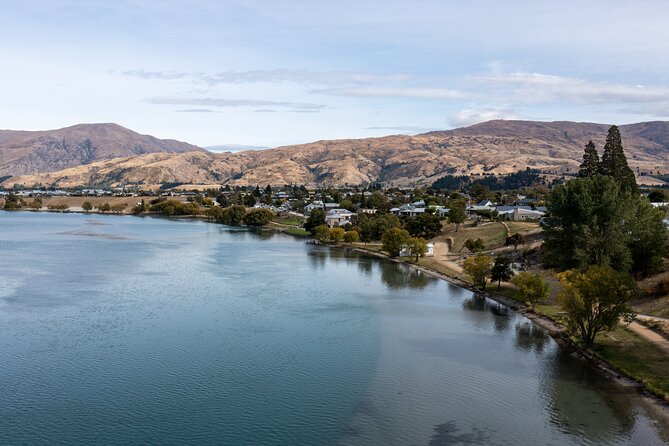
The final scenic section follows the dramatic Kawarau Gorge. The route takes in steep cliffs, turquoise water, Lake Dunstan, and the Gibbston wine region.
This is a strong ending to the day because the scenery becomes more dramatic as you approach Queenstown. The narrow gorge and river views provide a sharp contrast with the open high-country settlements earlier in the trip.
The route also carries stories of gold seekers, linking the final drive back to the mining history seen at St. Bathans and Ophir. You are not viewing isolated sights. The stops form a loose story about how people entered, worked, and settled the interior.
The road through the gorge may be the most visually impressive part for you, especially if you enjoy rugged river country. At the same time, the experience depends on the vehicle seat and weather. If you want a particular view, listen for the guide’s directions rather than waiting until the last moment.
Arriving in Queenstown With Hotel Drop-Off
The tour ends in Queenstown, with drop-off at centrally located accommodation. Hotel drop-off is included, which is a real advantage after a nine-hour day with luggage.
The service is not door-to-door from Dunedin. You need to get to the railway station at the start, but you avoid the trouble of arranging a taxi or transfer after arriving in Queenstown.
The luggage allowance is one large and one small bag per person. That is generous enough for a normal change of accommodation, but you should avoid bringing extra oversized items unless you confirm they can fit.
Accommodation itself is not included. You book and pay for your own place in Queenstown, and the drop-off applies to centrally located accommodation. If your lodging is outside the central area, check the exact arrangement before booking.
Is $179.97 Good Value?
At $179.97 per person, the price needs to be judged against what you would otherwise pay for transport and sightseeing. The included Taieri Gorge Train ticket is the key value item. You also receive the road transfer, a small-group guide, luggage space, and Queenstown hotel drop-off.
For someone already planning to travel from Dunedin to Queenstown, this can be a sensible use of the transfer day. You are not paying only for a seat in a vehicle. You are replacing a basic relocation with a train journey, several historical stops, and guided commentary.
The value is weaker if you only need to reach Queenstown quickly or if you already have a rental car. A car gives you more freedom to set your own pace and spend longer in St. Bathans, Cromwell, or Ophir. The tour’s advantage is convenience and interpretation, not complete flexibility.
The price also does not include meals or Dunedin pickup. Those are small details, but they affect your total planning. Children aged seven and under require a safety or booster seat, available to hire for NZ$20 per seat, or you can bring your own.
Who Should Choose This Day Trip?
I would recommend this experience to you if:
- You need to move from Dunedin to Queenstown and want the journey to count as sightseeing.
- You enjoy rail travel, old settlements, bridges, rivers, and regional stories.
- You prefer a small group to a large coach.
- You are comfortable with a full nine-hour day.
- You want your luggage transported and your Queenstown accommodation drop-off handled.
- You like having a guide explain the places you pass.
I would hesitate if you want long walks, flexible timing, or a relaxed lunch stop. The schedule is structured, and some stops are only five minutes. The train is scenic, but you still spend much of the day seated.
The moderate fitness requirement suggests you should be comfortable getting on and off the train and vehicle and walking around short stops. Nothing in the supplied details points to a strenuous hike, but this is not a completely stationary transfer.
Practical Details That Matter
The tour starts at 9:00 am at Dunedin Railway Station. Public transport is nearby, but Dunedin hotel pickup is not part of the service.
Your booking confirmation arrives at the time of booking. The group has a maximum of 15 people, and the tour requires a minimum number to operate. It also depends on good weather. If poor weather causes cancellation, you can choose another date or receive a full refund.
You can cancel for a full refund up to 24 hours before the start time. Changes or cancellations inside that 24-hour window are not accepted for a refund.
The tour has a perfect 5 rating from six ratings, and the strongest praise focuses on the two-part format and the guide’s personality. The train commentary and Jonathan’s humorous local stories appear to be central to the experience. That tells me this is best booked by people who value an entertaining guide as much as the scenery.
Should You Book the Dunedin to Queenstown Tour?
Book it if you want the route itself to be part of your South Island experience. The Taieri Gorge Train, St. Bathans, Ophir Bridge, Cromwell, and Kawarau Gorge create a day with far more character than a direct transfer.
I would especially choose it for a first visit to the region, for a solo visitor who wants company without a huge coach, or for anyone who does not want to drive unfamiliar roads with luggage in the car. The included train ticket and Queenstown hotel drop-off make the $179.97 price easier to justify.
Skip it if you need speed, privacy, or control over every stop. For everyone else, this is a smart way to connect two major bases while seeing the quieter Otago interior in between.
FAQ
Where does the tour begin?
It begins at Dunedin Scenic Train Tours, home of the Taieri Gorge Railway, at 22 Anzac Avenue, Railway Station, Dunedin 9016.
What time does the tour start?
The scheduled start time is 9:00 am.
Is Dunedin hotel pickup included?
No. You must make your own way to the Dunedin Railway Station meeting point.
How long does the experience take?
The full experience lasts approximately nine hours.
Is the Taieri Gorge Train ticket included?
Yes. The ticket from Dunedin to Pukerangi is included in the price.
Where do I leave the train?
You disembark at Pukerangi and meet the guide for the road journey to Queenstown.
How many people can join the tour?
The maximum group size is 15 people.
Is Queenstown hotel drop-off included?
Yes. You are dropped at centrally located Queenstown accommodation.
How much luggage can I bring?
The included luggage space allows one large bag and one small bag per person.
Are child safety seats provided?
Children aged seven and under must use a child safety or booster seat. Seat hire costs NZ$20 per seat, or you may bring your own.
Just added in Dunedin
- Otago Peninsula Tour and Larnach Castle City Sights (min 4 )★ 4.0 · 5 reviews
- Clearwater Private Penguin & Wildlife Tour from Port Otago (5hrs)★ 5.0 · 7 reviews
- Dunedin Nature & City Tour – Full Day Cruise Excursion★ 4.5 · 87 reviews
- Otago Peninsula Scenery and Dunedin City Highlights Tour★ 4.5 · 33 reviews
- Shore Excursion: Dunedin City, Otago Peninsula, Castle Gardens & Olveston Tour★ 5.0 · 81 reviews
- Castle, Coast & City Tour – 8 pax max – Castle Entrance Included★ 5.0 · 102 reviews
- Harbour, Albatross and Wildlife Cruise on Otago Harbour★ 4.5 · 22 reviews
- Dunedin Shore Excursion City Sightseeing & Tour of Larnach Castle★ 4.0 · 66 reviews
Train Experiences, compared.
Northern Explorer Train Journey from Wellington to Auckland
Read our review →
TranzAlpine Train, Arthur’s Pass and Castle Hill Day Trip
Read our review →
Coastal Pacific Train Journey from Picton to Christchurch
Read our review →
TranzAlpine Train Journey: Christchurch to Greymouth
Read our review →
Arthur’s Pass Discovery and TranzAlpine Train – Small Group Tour
Read our review →
Arthur’s Pass: TranzAlpine Train and Castle Hill Day Tour
Read our review →
Northern Explorer Train Journey from Auckland to Wellington
Read our review →
Arthur’s Pass and TranzAlpine Train Day Tour from Christchurch
Read our review →Browse the lists this tour appears in