
REVIEW · LAKE TEKAPO TOURS
Stargazing Experience at Cowan’s Private Observatory
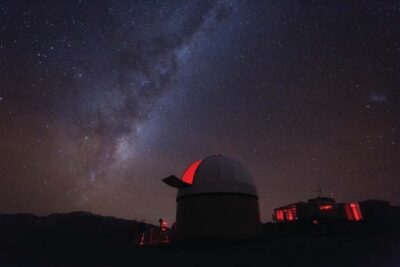
The Southern sky does the heavy lifting. Cowan’s Private Observatory gives you a comfortable introduction to stargazing in Lake Tekapo, with a short shuttle from town, sheltered viewing craters, powerful telescopes, and guides who explain what you are seeing. I like the way the experience suits first-time stargazers, and I like that the guide adjusts the session to the stars, planets, and constellations visible that night.
The setting inside the Aoraki Mackenzie International Dark Sky Reserve is the main reason to book. The private craters protect you from wind and stray light, while the small maximum group size of 22 keeps the session more personal than a large bus tour. The main drawback is simple: weather controls the show, and even a clear afternoon can turn into a cloudy night. There is also no guarantee that every planet or galaxy will be visible during your visit.
In This Review
- Key points before you book
- Why Lake Tekapo is made for stargazing
- Starting at the Dark Sky Project base
- Inside Cowan’s sheltered private craters
- How the telescope session works
- What happens when the weather turns bad
- Is the $82.11 price good value?
- The best time to choose your session
- Who will enjoy this experience most
- Practical advice for a better night
- FAQ
- How long does the Cowan’s Private Observatory experience last?
- Where do I meet for the tour?
- Is the observatory wheelchair accessible?
- What age can children be?
- What happens if the weather is too poor for stargazing?
- Can I cancel my booking for a refund?
- Should you book Cowan’s Private Observatory?
Key points before you book
- A five-minute shuttle takes you from the Dark Sky Project base to Cowan’s Private Observatory.
- Sheltered craters make the experience more comfortable than standing in an open field.
- Powerful telescopes may reveal the Moon, Jupiter, Saturn, star clusters, galaxies, and more.
- The guide shapes the session around what is visible that night, so every visit can differ.
- Children from age five can join, and visitors aged 17 and under receive discounted tickets.
- Bad weather can lead to a different date, an indoor option, or a full refund.
Why Lake Tekapo is made for stargazing
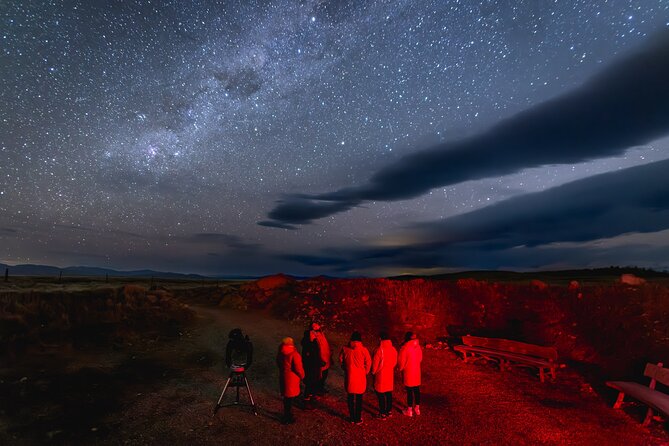
Lake Tekapo sits within the Aoraki Mackenzie International Dark Sky Reserve, a Gold Standard reserve known for exceptionally dark and clear skies. That matters because artificial light is the enemy of stargazing. The less light scattered through the air, the more stars you can pick out with your own eyes.
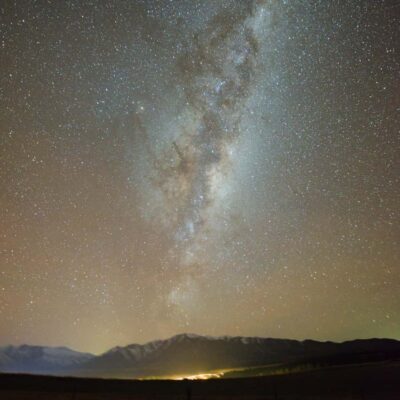
You are not simply looking at a few bright stars through a telescope. On a good night, the Milky Way can appear as a broad band across the sky, and the Southern Hemisphere offers sights that many Northern Hemisphere visitors rarely see. The Southern Cross is one of the key southern constellations, and guides may point out planets, star clusters, galaxies, and other features that are easy to miss without help.
I like that this experience does not assume you already know the difference between a nebula and a constellation. It is designed for beginners, families, and curious adults who want a clear explanation without needing an astronomy background.
The reserve does not guarantee a perfect night, of course. Clouds, moonlight, seasonal changes, and the hour of the evening all affect what you can see. The important point is that you are starting with one of the best possible locations, then adding equipment and guidance to make the most of the conditions.
More Lake Tekapo trips:
- Lake Tekapo: Alpine Stargazing Experience with a Guide
★ 4.5 · 626 reviews - Lake Tekapo: Stargazing Experience
★ 4.9 · 607 reviews - From Christchurch: Mount Cook & Lake Tekapo Day Tour & Lunch
★ 4.6 · 405 reviews
Starting at the Dark Sky Project base
Your evening begins at the Dark Sky Project base in Lake Tekapo Park, close to Tekapo township. This is the check-in point, not the main viewing site, so do not head straight to the observatory unless the staff specifically tells you to do so.
From the base, you take the included shuttle to Cowan’s Private Observatory. The drive is listed as about five minutes, which keeps the transfer easy and avoids the need to arrange your own ride in the dark.
This setup is useful if you are staying near the town center or using public transport. Hotel pickup and drop-off are not included, so you need to make your own way to the Dark Sky Project base. Give yourself enough time to locate it, especially if your session begins late at night.
Check your booking carefully if you choose a time after midnight. The date can be confusing because a session beginning shortly after midnight belongs to the following calendar day. This is a small detail, but it can cause a major problem if you arrive on the wrong night.
The total experience lasts about one hour and 30 minutes. The first part is the check-in and transfer, followed by roughly one hour and 15 minutes at the observatory. The precise flow may vary with the night’s viewing conditions and the guide’s plan.
Inside Cowan’s sheltered private craters
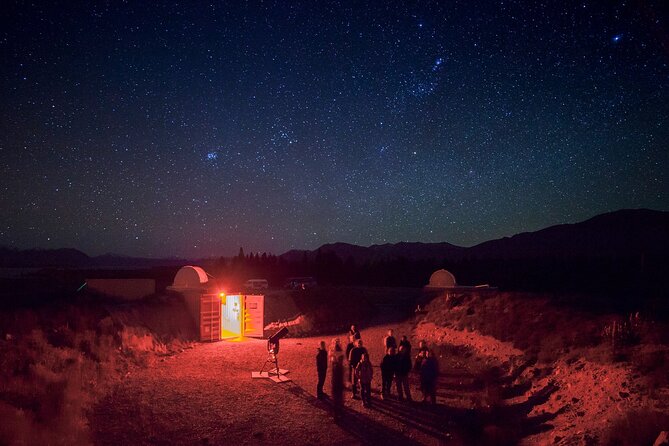
Cowan’s Private Observatory uses purpose-built craters as its viewing spaces. These are designed to shield you from wind and nearby light, giving you a more comfortable place to look upward.
That shelter is one of the tour’s most practical features. A clear winter sky can still feel brutally cold, and a steady breeze makes standing still at a telescope even less pleasant. The craters do not turn the experience into an indoor activity, but they make the outdoor portion easier to enjoy.
You should still dress warmly all year. Bring several layers, a warm hat, and gloves if you feel the cold easily. Even during warmer months, the night can feel much colder than the daytime around Lake Tekapo.
The private setting also helps the experience feel focused. The group maximum is 22 people, which is not tiny, but it is manageable for a guided telescope session. You will not be wandering between a large collection of unrelated exhibits. Instead, the guide directs your attention to the sky and the equipment.
The observatory is accessible to wheelchair users, another useful advantage for a site that might otherwise sound difficult to reach. If you have specific mobility needs, it is still sensible to confirm the details before booking, but the facility is designed with wheelchair access in mind.
How the telescope session works
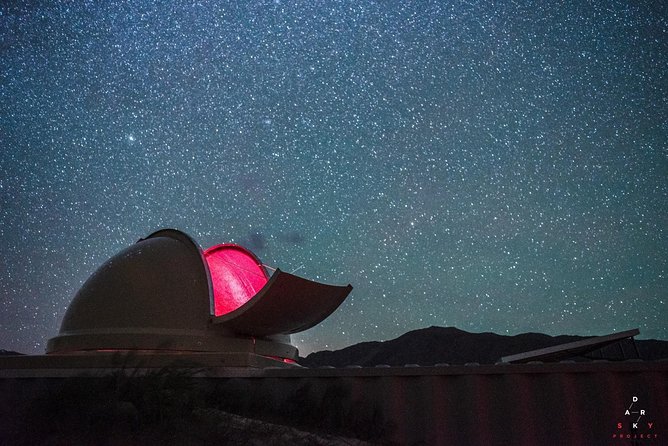
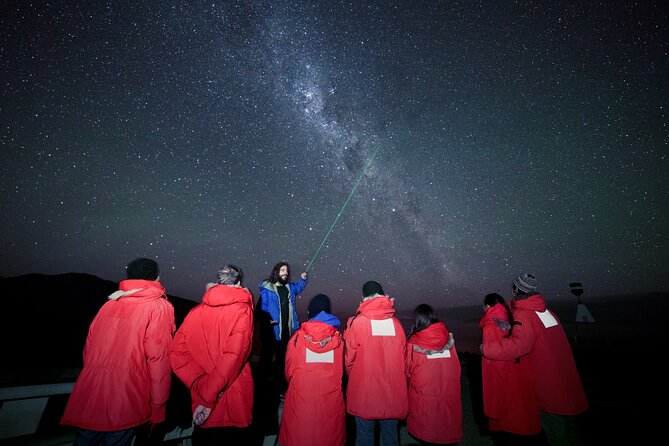
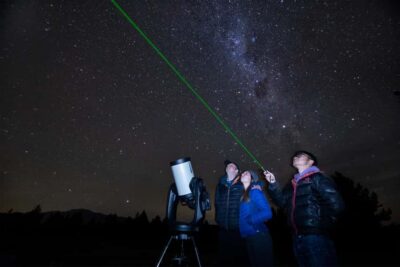
The guide uses handheld lasers to identify stars and constellations, then brings selected objects closer through powerful telescopes. This combination is important. Looking through a telescope without knowing where it is aimed can feel random, while a laser pointer alone cannot show you the detail of a planet or distant object.
The guide first helps you understand the wider sky. You might be shown a familiar constellation, a planet, or a prominent southern feature. Then the telescope gives you a closer look.
Your viewing list depends on the season, the time of night, cloud cover, and what is above the horizon. On different evenings, you might see the Moon, Jupiter, Saturn, star clusters, galaxies, or part of a constellation. One particularly rewarding possibility is Saturn with its rings visible through the telescope. That kind of sight can be far more striking than a photograph because you are seeing it directly through the instrument.
Jupiter can also be a memorable target. The Moon is usually easier to identify and may reveal strong detail through a telescope, while star clusters can appear as dense groups of points rather than a single bright star.
I appreciate that the guide does not promise a fixed checklist. A rigid program would be less honest because the sky changes constantly. Instead, the session responds to the actual conditions. On one night, the focus may be a planet. On another, the Milky Way or a southern constellation may provide the best view.
The guide also provides context, not just directions. The astronomy explanations are intended to be both educational and entertaining, which helps children stay engaged. Families have found the night especially memorable when the sky is clear, but younger children may struggle with the late hour or cold. The minimum age is five, and children must be accompanied by an adult.
More stargazing nights in Lake Tekapo:
- Chameleon Stargazing Shared Tour
★ 5.0 · 181 reviews - Lake Tekapo: Mountaintop Stargazing at Mount John Summit
★ 4.5 · 176 reviews - Mount John Observatory Stargazing Experience, Tekapo
★ 4.5 · 160 reviews - Silver River Stargazing Experience in Lake Tekapo
★ 4.5 · 106 reviews
What happens when the weather turns bad
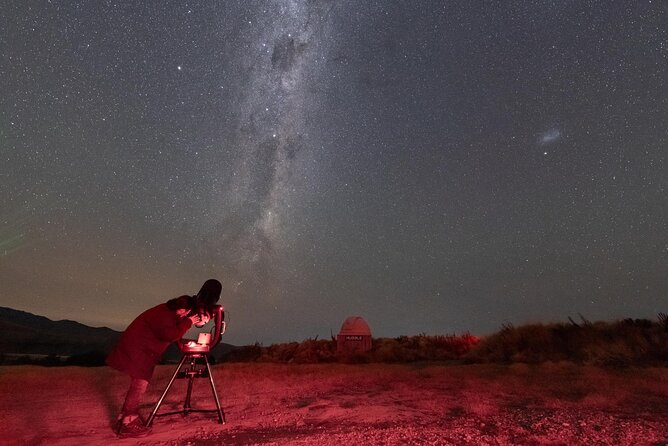
Weather is the largest uncertainty in any stargazing activity. Clouds can block the sky, and poor viewing conditions can make a telescope session pointless even when it is not raining.
If the weather prevents the tour from operating, the provider may offer an indoor alternative. One indoor session was described as worthwhile, and the sky later cleared enough for additional stargazing in the countryside. That is a reminder that conditions can change quickly around Lake Tekapo, though you should not count on a second outdoor opportunity during your own booking.
If the experience is canceled because of poor weather, you can be offered another date or a full refund. This weather policy gives the $82.11 price some protection. You are not simply gambling the full cost on a cloudless forecast.
Still, think about your schedule before booking. If you have only one night in Tekapo, a cancellation may leave you disappointed even if you receive fair treatment. If stargazing is a major reason for your visit, consider allowing two nights in the area when possible. That gives you a better chance of finding a workable evening.
The cancellation policy also allows you to cancel for a full refund up to 24 hours before the start time. Changes or cancellations made inside that window are not accepted for a refund. The cut-off uses local time.
Is the $82.11 price good value?
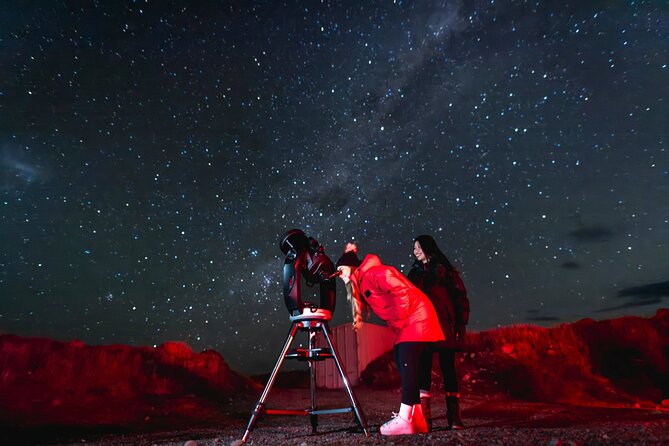
At $82.11 per person, this is not a casual walk outside to look at the stars. You are paying for access to a private facility, return shuttle transport, telescopes, sheltered viewing spaces, and an astronomy guide.
I think the price makes the most sense for visitors who want help interpreting the sky. You could look up from the lakeside on your own for free, but you would miss the structure, equipment, and explanations that turn random points of light into named places and objects.
The value is stronger for families. Discounted tickets apply to visitors aged 17 and under, and the experience offers children a direct way to see planets and the Milky Way rather than only hearing about them. A clear view of Saturn’s rings or Jupiter can give a child a lasting memory, especially when the guide explains what the telescope is showing.
The value is less certain if your main goal is to photograph the sky. The information provided focuses on guided viewing through telescopes, not astrophotography, camera support, or photography instruction. Book this as an experience for seeing and understanding the night sky, not as a technical photo workshop.
The limited group size also matters. With no more than 22 people, you should have a reasonable chance to participate without the session feeling like a mass attraction. That said, telescope viewing takes time, so patience is still needed when several people are waiting for the same target.
The best time to choose your session
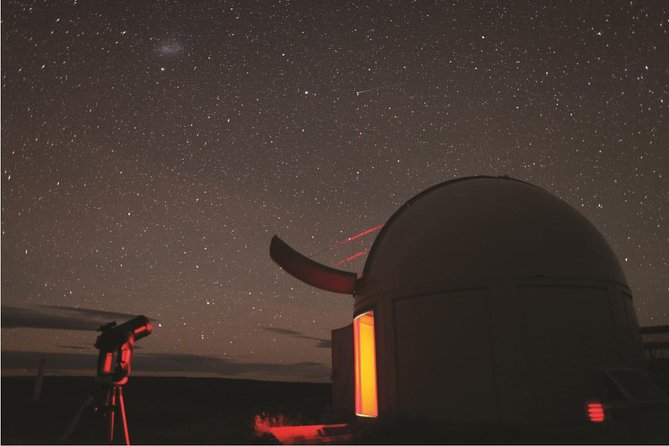
The timing affects both comfort and what appears above you. A late session may offer darker skies, but it can be tiring for children and difficult for anyone who needs to be up early the next morning.
After-midnight bookings require special care with the date. Double-check the calendar date shown during booking and on your mobile ticket. The provider supplies downloadable mobile e-tickets, so you do not need access to a printer.
The night’s visible objects depend partly on the hour. A planet that is visible early may be lower or no longer available later, while other features become easier to see as the evening progresses. The guide makes the final choices based on those conditions.
If you have flexibility, choose the evening that gives you the best weather forecast, but treat the forecast as guidance rather than a promise. The tour can be canceled when viewing conditions are poor, and an indoor option may be offered instead.
Who will enjoy this experience most
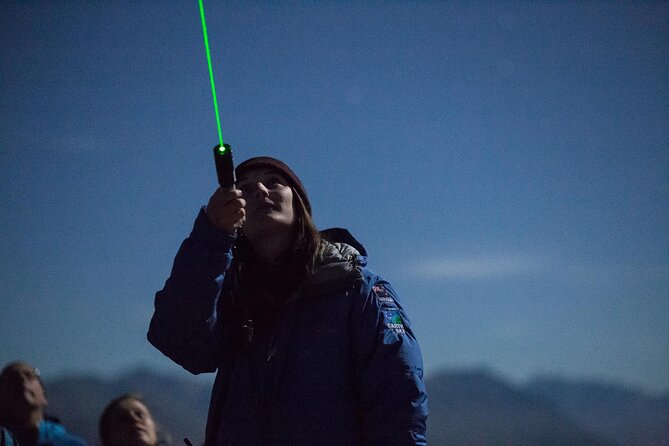
This is a strong choice for first-time stargazers who want a clear introduction without having to learn the sky alone. The guide, laser pointers, telescopes, and protected viewing area remove much of the guesswork.
Families with children aged five and older are also well served, especially when the forecast is good. The session is educational without needing to feel like a classroom, and the possibility of seeing Jupiter, Saturn, the Moon, or star clusters gives children a clear reason to stay interested.
It also suits couples and solo visitors who want a quieter evening activity in Tekapo. You do not need specialist equipment or prior astronomy knowledge. The main requirement is that you can speak the language used on the tour for health and safety reasons. If you cannot, you will not be allowed to join.
You may want to skip it if you dislike cold evenings, struggle with late-night activities, or need a guaranteed list of celestial objects. The experience depends too much on nature for that promise to be realistic.
Practical advice for a better night
Arrive at the Dark Sky Project base with time to spare. One late arrival led to a missed shuttle, and staff could not send another vehicle after it had departed. Midnight sessions can be especially tricky because tired children may be slow to get ready, so plan your departure from your accommodation carefully.
Bring warm clothing even if the afternoon felt mild. The viewing area is sheltered from wind, but you remain outside for much of the experience, and one clear autumn evening was described as very cold.
Keep your expectations flexible. The best night may bring several major sights, including the Southern Cross, Jupiter, Saturn, and star clusters. Another night may offer fewer telescope targets but still provide an impressive view of the Milky Way.
Food and drinks are not included unless specifically stated, so eat before you go if you expect to be hungry. Hotel pickup and drop-off are also not included. Your mobile ticket is enough for check-in.
FAQ
How long does the Cowan’s Private Observatory experience last?
The experience lasts approximately one hour and 30 minutes. This includes check-in and transport from the Dark Sky Project base, followed by about one hour and 15 minutes at the observatory.
Where do I meet for the tour?
You check in at the Dark Sky Project base in Lake Tekapo Park, near Tekapo township. A shuttle then takes you to Cowan’s Private Observatory.
Is the observatory wheelchair accessible?
Yes. Cowan’s Private Observatory is accessible to wheelchair users.
What age can children be?
The minimum age is five. Children must be accompanied by an adult, and visitors aged 17 and under receive discounted tickets.
What happens if the weather is too poor for stargazing?
If poor weather prevents the experience from operating, you may be offered another date or an indoor alternative. If the tour is canceled because of weather, a full refund is available.
Can I cancel my booking for a refund?
Yes. You can cancel at least 24 hours before the local start time for a full refund. Cancellations or changes made less than 24 hours before the experience are not accepted for a refund.
Should you book Cowan’s Private Observatory?
I would book this if you want an easy, guided introduction to the southern night sky and you have at least some flexibility around the weather. The sheltered craters, small maximum group, return shuttle, and strong telescopes make it more useful than simply stepping outside and hoping you can identify something.
The clearest reason to choose it is the chance to see a planet such as Saturn or Jupiter through a telescope while a guide explains what you are seeing. For families, that can be worth the full price, especially with discounted youth tickets.
Book with warm clothes, arrive early, and keep your plans flexible. If the sky cooperates, Cowan’s Private Observatory can turn a cold night in Tekapo into one of the most memorable parts of your South Island visit.
Just added in Lake Tekapo
- Queenstown to Lake Tekapo via Mt Cook One-Way Small Group Tour★ 4.5 · 13 reviews
- Queenstown to Christchurch One-Way Tour via Mt Cook & Lake Tekapo★ 4.5 · 134 reviews
- Queenstown to Christchurch One Way Tour Via Lake Tekapo & Mt Cook★ 5.0 · 10 reviews
- Private 3 Day Queenstown Glenorchy Wanaka and Tekapo★ 5.0 · 3 reviews
- Mount Cook & Lake Tekapo the Ultimate combo from Queenstown★ 5.0 · 3 reviews
- Mt. Cook Private Day Trip From Queenstown with Lake Tekapo★ 5.0 · 10 reviews
- Lake Tekapo Private Day Trip from Queenstown★ 5.0 · 7 reviews
- Mt Cook to Christchurch One-Way Small Group Tour via Lake Tekapo★ 5.0 · 16 reviews
Lake Tekapo Tours, compared.
Mount Cook, Lake Tekapo and Tasman Glacier Tour from Christchurch
Read our review →
Tekapo Shuttle: Mt Cook Day Tour via Pukaki & Tasman Lake
Read our review →
Mount Cook & Lake Tekapo Day Tour from Christchurch with Lunch
Read our review →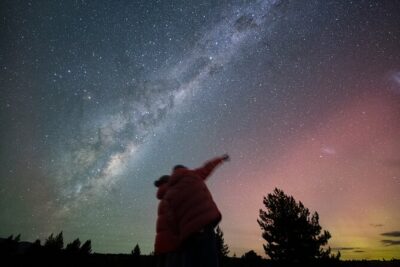
Browse the lists this tour appears in